Digital advertising is no longer a game of spray-and-pray. Artificial intelligence has fundamentally rewired how brands reach, engage, and convert their audiences — and the pace of change is accelerating faster than most business owners realize.
According to Salesforce’s State of Marketing 2026 report, 87% of marketers now use generative AI in at least one workflow — up from just 51% in 2024. Non-adoption isn’t just a missed opportunity anymore. It’s a competitive liability.
Whether you’re a startup founder managing your own ads or a CMO overseeing a multi-channel strategy, understanding how AI is reshaping digital advertising is no longer optional. It’s the difference between scaling intelligently and burning budget on campaigns that never had a chance.
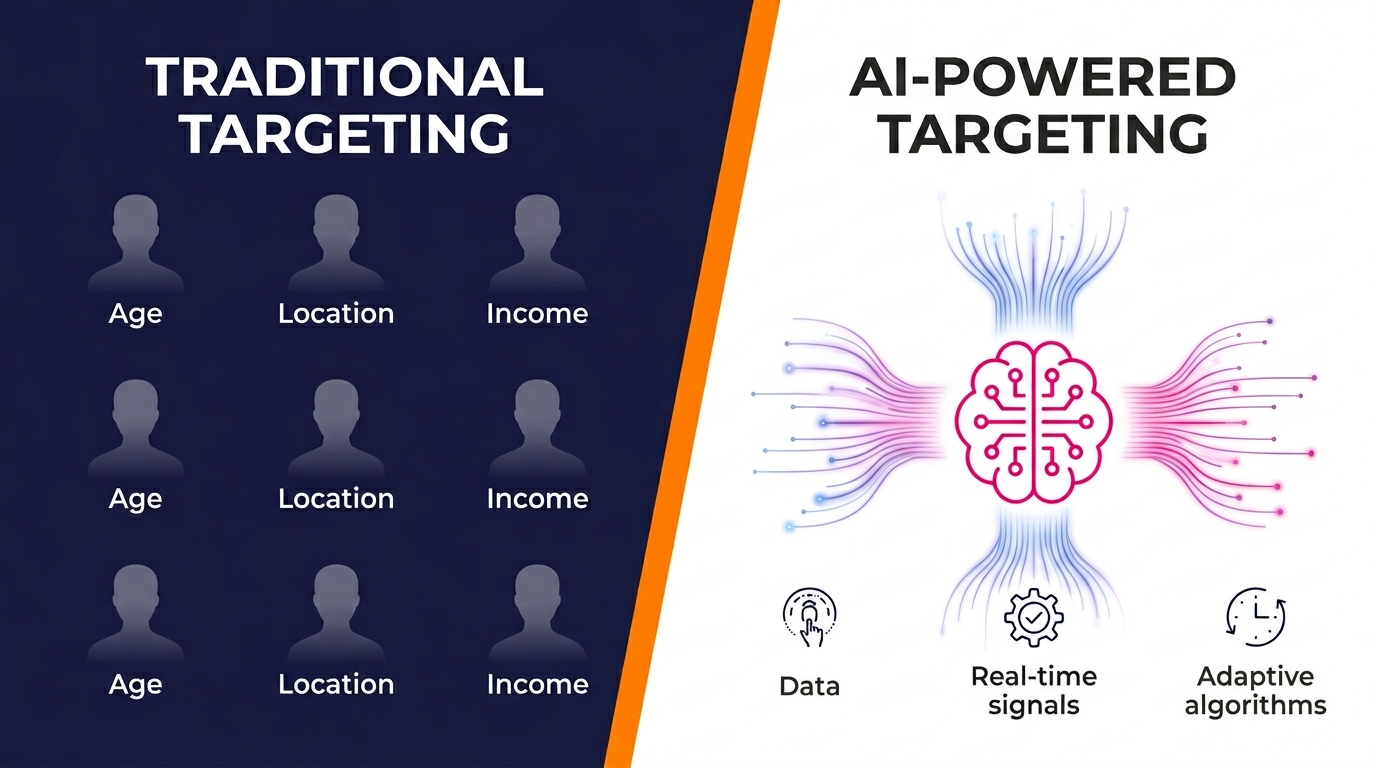
Traditional digital advertising ran on demographics. You targeted users by age, location, income bracket, and job title. It worked — until it didn’t. Privacy regulations tightened. Third-party cookies crumbled. Audience data became less reliable and harder to act on.
AI stepped into that gap and built something far more powerful.
According to StackAdapt’s State of Programmatic Advertising 2026 report, platforms using first-party data combined with AI-based contextual targeting now deliver up to 2X higher return on ad spend compared to traditional third-party targeting approaches. That’s not a marginal improvement — that’s a fundamental shift in what’s possible.
Instead of targeting who someone is, AI now targets what someone is actively doing, thinking, and searching for — in real time.
Personalization used to mean putting someone’s first name in an email subject line. Today, it means dynamically assembling an ad — the headline, image, offer, and format — based on exactly who is seeing it and exactly when they’re seeing it.
This is called Dynamic Creative Optimization (DCO), and it’s one of the most powerful tools AI has handed marketers. The same StackAdapt programmatic research found that campaigns using DCO deliver a 32% higher click-through rate and a 56% lower cost per click compared to static creative formats. That’s not just efficiency. That’s a complete reimagining of how creative performs.
The AI doesn’t guess. It tests. It learns. Then it scales whatever works — instantly, across thousands of audience segments simultaneously.
Adobe’s 2026 AI and Digital Trends report, drawn from a global survey of 4,000 consumers, confirms that audiences disengage from experiences that feel irrelevant or poorly timed — often within five seconds of exposure. DCO removes that problem by ensuring the right message meets the right person at the right moment, every time.
One of the most exciting — and underutilized — capabilities of AI in advertising is prediction. Not hindsight. Not optimization after the fact. True pre-launch forecasting.
Smartly’s 7th Annual Digital Advertising Trends Report, built from insights gathered from 450 marketing leaders worldwide, found that 31% of marketers say their top priority is using AI predictive models to forecast campaign performance before launch — with another 40% wanting to pre-test creative against synthetic audiences before committing a cent.
This changes the entire risk profile of digital advertising. Instead of running a campaign and hoping for results, AI lets you model those results — and refine your approach — before a single dollar leaves your account.
McKinsey’s research, cited within StackAdapt’s programmatic advertising analysis, found that 24% of marketing and sales teams reported revenue gains of 6% or more from AI in the past year alone. The brands seeing those gains aren’t the biggest ones. They’re the most strategic ones.
You don’t need a separate AI stack to take advantage of this revolution. The tools are already embedded in the platforms running your campaigns.
JumpFly’s monthly AI in Online Advertising research reports that Google’s Gemini-powered Performance Max and AI Max campaigns generated nearly 70 million creative assets for advertisers in Q4 2025 alone. Meta’s Advantage+ now automates bidding, audience targeting, creative assembly, and placement — and per JumpFly’s April 2026 advertising trends coverage, Meta has publicly committed to reaching fully automated, end-to-end ad creation before the close of 2026.
This means the platforms aren’t offering AI as an add-on. They’re assuming it. Human marketers are increasingly shifting from hands-on campaign managers to strategic directors — defining the goal and letting AI execute.
The same JumpFly research, citing the Digital Marketing Institute, found that 44% of users who have tried AI-powered search now call it their primary source for internet searching. Your audience has already moved. Your advertising strategy needs to follow.
AI’s impact isn’t limited to paid advertising. It’s transforming organic visibility too — at a speed that’s leaving slow-moving businesses behind.
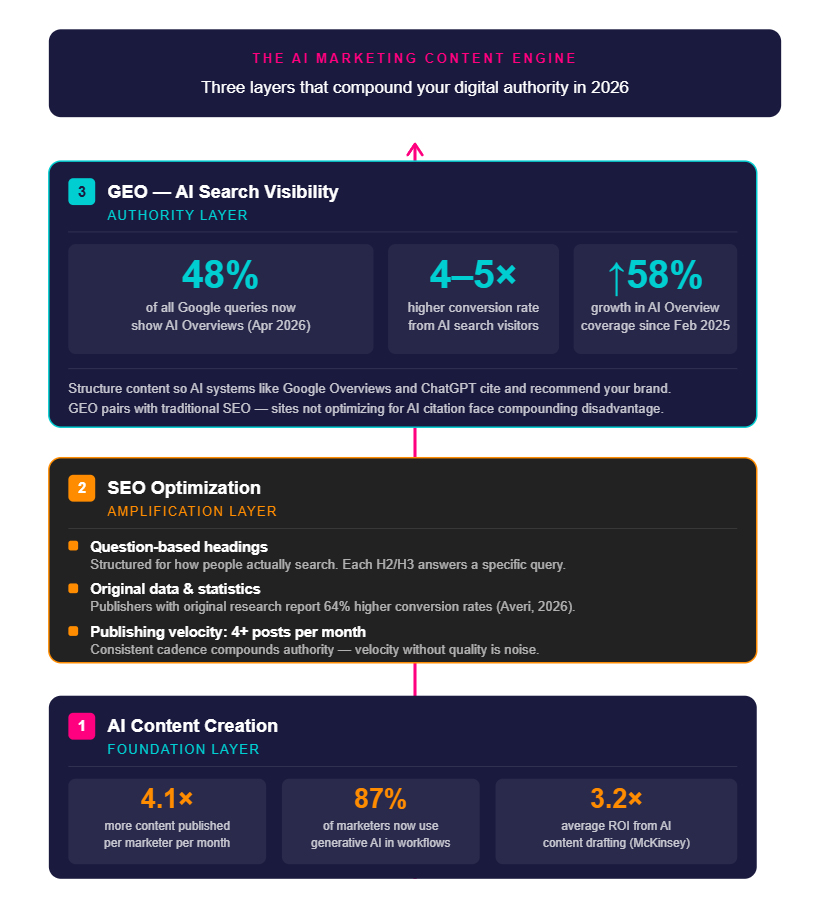
Averi’s State of AI Content Marketing 2026 Benchmarks Report reveals that as of April 2026, AI Overviews now appear on 48% of all Google queries, reaching 2 billion monthly users — a 58% increase from just 31% in February 2025. If your content isn’t structured to be cited by AI search systems, you’re invisible to a massive and growing share of searchers.
The same Averi research found that AI search visitors convert at 4 to 5 times the rate of traditional organic traffic. That number alone should reshape your content strategy.
The brands winning in AI-driven search are publishing original research, structuring their content with clear answers and FAQ sections, and pairing traditional SEO with Generative Engine Optimization (GEO) — ensuring their expertise gets surfaced, cited, and clicked.
HubSpot’s AI Trends 2026 data, drawn from 14,000 respondents, shows that teams which adopted AI content tools now produce 4.1 times more published content per marketer per month than pre-adoption baselines. Velocity and quality, together — that’s the content engine model.
AI is a multiplier — not a replacement for strategy, creativity, or brand judgment.
Smartly’s 2026 Digital Advertising Trends Report found that three in four marketers are concerned that AI-generated creative risks making brands look and sound the same — and 86% have already seen AI outputs that closely resemble competitor content. The opportunity isn’t faster production alone. It’s distinctive, brand-authentic creative powered by AI that enhances originality instead of eroding it.
The same StackAdapt programmatic research highlights a critical governance gap: while over 70% of marketers have encountered AI-related issues such as hallucinations, bias, or off-brand content, fewer than 35% plan to increase investment in AI governance or brand integrity oversight in 2026. That gap is exactly where your competitive advantage lives. Brands that build structured human oversight into their AI workflows will produce content that earns trust — and trust is what drives conversions.
HubSpot’s 2026 State of Marketing Report puts it plainly: 61% of marketers believe the industry is experiencing its biggest disruption in 20 years. The gap in 2026 isn’t who is using AI — it’s how well they’re using it.
Use this as your quick-reference audit. Check off what you’ve implemented — and flag what needs attention.
Paid Advertising
☐ You’re using AI-powered bidding strategies on Google and Meta (Performance Max, Advantage+)
☐ Dynamic Creative Optimization (DCO) is active on at least one campaign
☐ You’re using first-party data — email lists, CRM segments — to fuel AI targeting
☐ You’ve tested AI predictive tools to forecast performance before launch
Content & SEO
☐ Your content includes original research, statistics, and FAQ sections
☐ Blog posts are structured with question-based headings for AI search citation
☐ You’re publishing consistently — minimum 4 posts per month — to compound organic authority
☐ Your strategy includes Generative Engine Optimization (GEO), not just traditional SEO
Brand Integrity
☐ AI-generated content goes through a human review layer before publishing
☐ Your brand voice guidelines are documented and applied to all AI outputs
☐ You audit AI creative outputs regularly for competitor similarity and off-brand drift
Analytics & Governance
☐ You’re measuring AI tool ROI — not just usage
☐ A defined human is accountable for AI quality control in your marketing workflow
☐ You’ve established clear policies on what AI should — and shouldn’t — produce
AI marketing is no longer a future investment. It’s the current standard. The brands gaining market share in 2026 are the ones that have moved from experimenting with AI to building it into the foundation of their advertising, content, and growth strategies.
The question isn’t whether AI will transform your industry. It already has. The question is whether your business is positioned to capture that momentum — or watch a competitor do it instead.
Drive smarter campaigns. Unlock better targeting. Transform your results with a strategy built for the way digital advertising actually works today.
For more information about Outreach Brands’ forward-thinking digital marketing services, complete the online request form below.
For more information about Outreach Brands’ forward-thinking digital marketing services, complete the online request form below.