Search is no longer what it was five years ago. Not even what it was last year.
For decades, ranking on Google meant mastering a relatively predictable set of rules: keywords, backlinks, page speed, and content quality. That formula still matters — but it’s no longer the whole game.
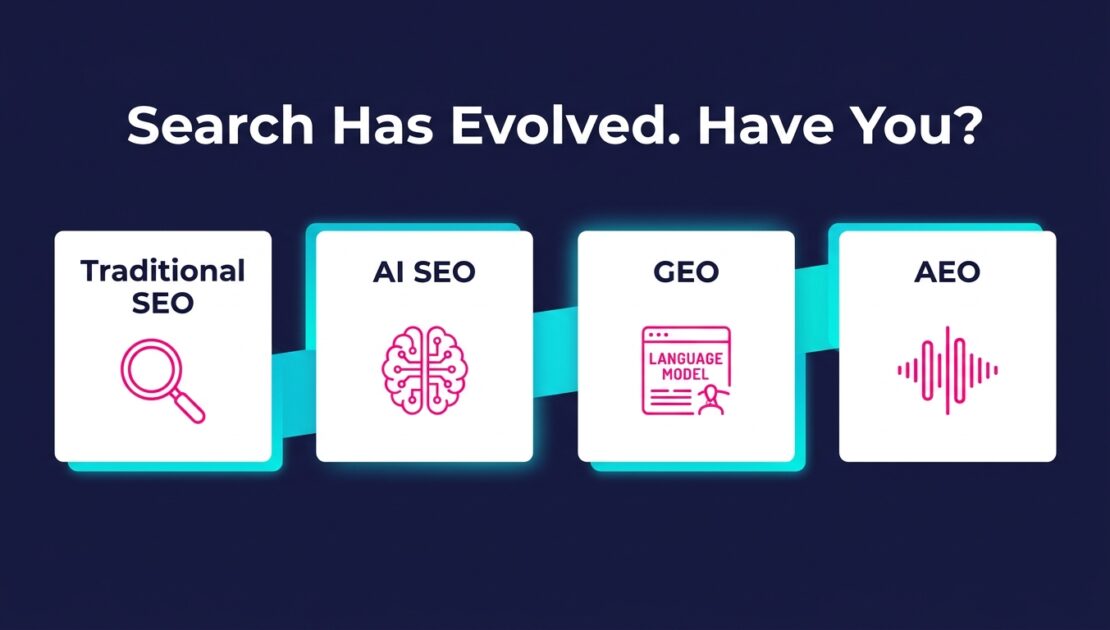
Artificial intelligence has fundamentally reshaped how search engines find, process, and present information. New terms are emerging fast: AI SEO. GEO. AEO. If you’re a business owner, CMO, or digital entrepreneur trying to stay visible online, understanding the difference isn’t optional anymore. It’s competitive survival.
Let’s break it all down — clearly, practically, and without the fluff.
Traditional SEO (Search Engine Optimization) is the practice of optimizing your website so it ranks higher in organic search engine results — primarily Google’s blue-link results page.
The core pillars have always been:
- On-page SEO — optimizing content, headlines, meta tags, and keywords
- Technical SEO — improving site speed, mobile-friendliness, crawlability, and structured data
- Off-page SEO — earning backlinks from authoritative websites to signal credibility
- Content Marketing — publishing high-quality, relevant content that answers real user questions
Traditional SEO is built on a simple premise: help search engines understand what your page is about so they can match it to the right queries. Done right, it drives consistent, compounding, cost-effective organic traffic.
It still works. It still matters. But it is no longer the only battleground.
AI SEO is the practice of optimizing your digital content and website specifically for AI-powered search experiences — including Google’s AI Overviews (formerly Search Generative Experience), ChatGPT Search, Perplexity AI, and similar platforms.
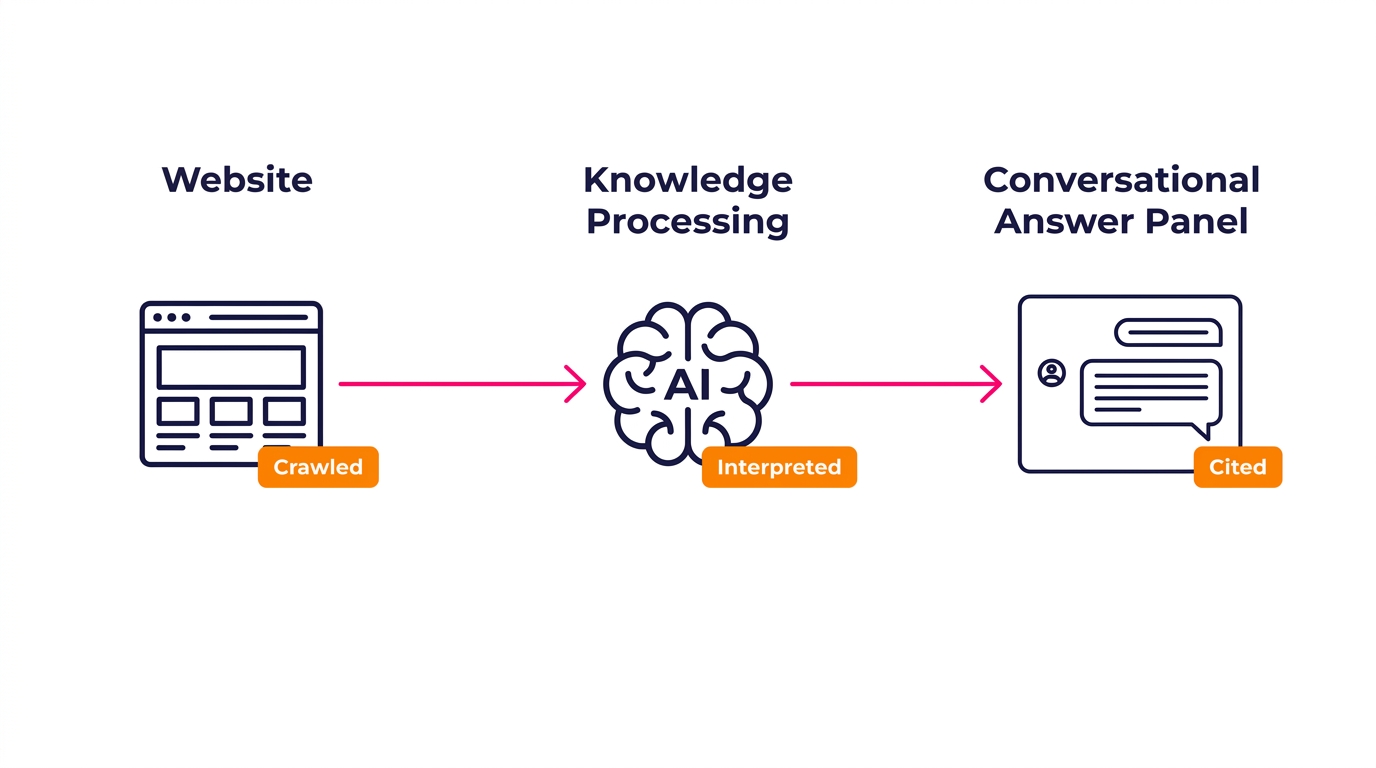
Here’s the critical shift: traditional search engines return a list of links. AI search engines return an answer — synthesized from multiple sources, delivered conversationally, often without the user needing to click anything at all.
That changes everything about how visibility works.
With AI SEO, the goal isn’t just to rank on page one. It’s to become the source that AI systems cite, quote, and trust when generating answers for your target audience.
AI SEO includes — but goes beyond — traditional optimization by focusing on:
- Topical authority — demonstrating deep, comprehensive expertise on a subject area
- Entity optimization — helping AI understand who you are, not just what your page says
- Conversational query alignment — structuring content to answer the way people actually ask questions
- Structured data and schema markup — feeding AI systems clean, machine-readable signals
- E-E-A-T reinforcement — proving Experience, Expertise, Authoritativeness, and Trustworthiness at every layer of your digital presence
In short: AI SEO is traditional SEO, evolved for a world where the search engine doesn’t just point to your content — it reads it, interprets it, and decides whether to speak it on your behalf.
GEO — Generative Engine Optimization — is a subset of AI SEO that focuses specifically on optimizing content to appear within the generated responses of large language model (LLM)-powered search engines and tools.
Think Google AI Overviews, Bing Copilot, Perplexity, and similar platforms that don’t just retrieve results — they generate them.
GEO asks a different question than traditional SEO. Instead of “How do I rank for this keyword?”, GEO asks: “How do I get cited inside an AI-generated answer?”
Research from Princeton, Georgia Tech, and other institutions has found that certain content strategies significantly increase the likelihood of being cited in AI-generated responses. These include:
- Citing credible statistics and data within your content
- Using clear, quotable sentences that directly answer specific questions
- Structuring content with unambiguous headings and logical flow
- Establishing brand authority through consistent, expert-level publishing over time
GEO is still an emerging discipline, but businesses that begin adapting now will hold a significant first-mover advantage as generative search continues to grow.
AEO — Answer Engine Optimization — is the practice of structuring your content specifically to be selected as the direct answer to a user’s question, whether by a voice assistant, a featured snippet, an AI Overview, or another answer-format interface.
AEO predates the current AI wave. It became relevant when Google introduced Featured Snippets (the “position zero” answer boxes at the top of results). But its importance has exploded alongside the rise of voice search (Siri, Alexa, Google Assistant) and AI chat interfaces.
The core principle of AEO is simple: answer the question clearly, early, and concisely.
Tactics that drive AEO performance include:
- Writing a direct answer to your target question within the first 50–100 words of a section
- Using FAQ-format content that mirrors natural language questions
- Implementing structured data markup (FAQ schema, How-To schema, Speakable schema)
- Keeping answers between 40–60 words for voice and snippet optimization
- Targeting question-based keywords (“What is…,” “How do I…,” “Why does…”)
AEO is essentially the discipline of making your content the answer — not just a document that contains relevant information.
These four disciplines are related, overlapping, and increasingly interconnected. Here’s how they stack up:
| Discipline |
Primary Goal |
Main Target Platform |
Key Tactic |
Maturity Level |
| Traditional SEO |
Rank in blue-link results |
Google, Bing |
Keyword optimization + backlinks |
Established |
| AI SEO |
Appear in AI-powered search experiences |
Google AI Overviews, ChatGPT Search, Perplexity |
Topical authority + entity optimization |
Rapidly growing |
| GEO |
Get cited inside generated AI answers |
LLM-based engines (Perplexity, Gemini, Copilot) |
Quotable content + data citations |
Emerging |
| AEO |
Become the direct answer to a query |
Voice assistants, featured snippets, AI chat |
FAQ structure + schema markup |
Growing |
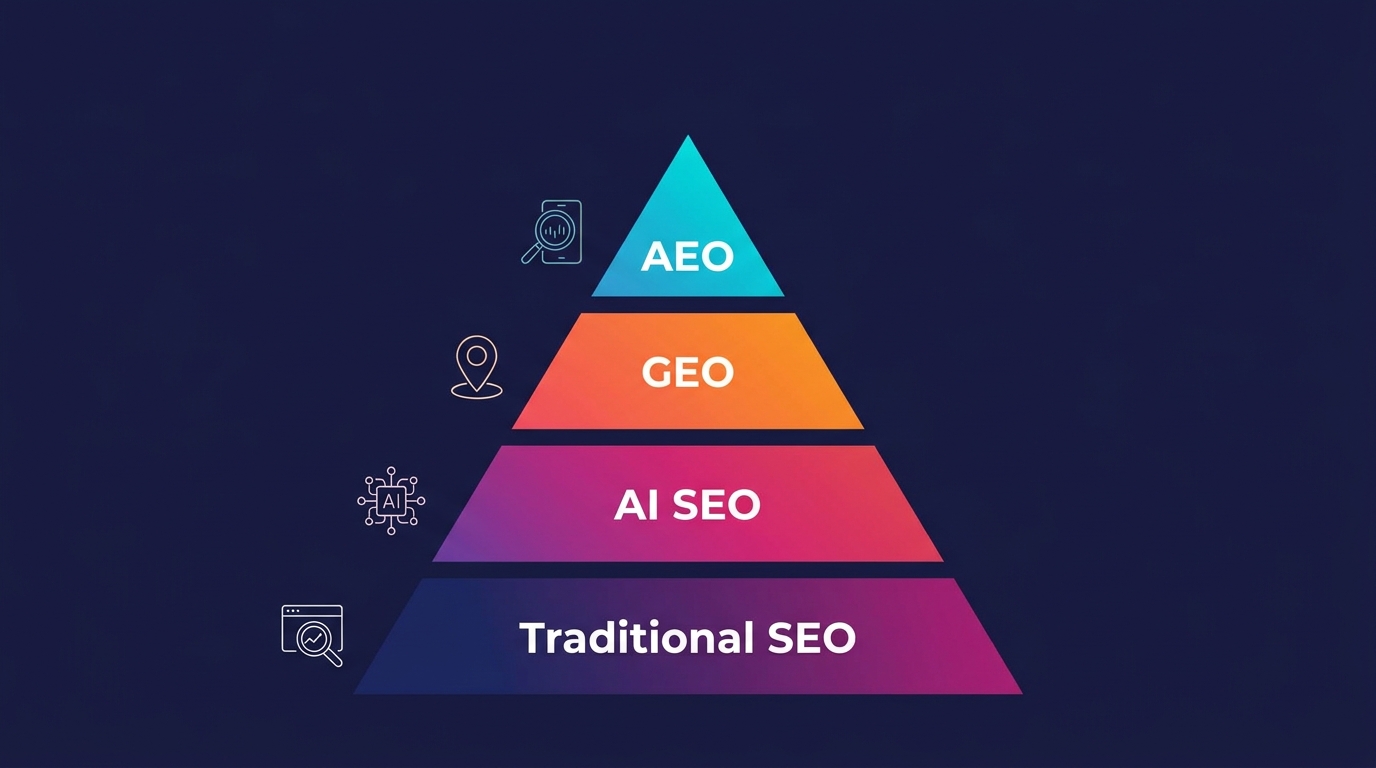
The takeaway: these aren’t competing strategies. They’re layers of the same modern search optimization stack. A winning strategy in 2025 and beyond incorporates all four — with the balance adjusted based on your audience, industry, and goals.
Search behavior is shifting faster than most businesses realize.
According to multiple industry reports, AI-generated search responses are now appearing for a significant and growing percentage of Google queries. ChatGPT crossed 100 million daily active users. Perplexity’s growth has been exponential. Voice search continues to rise, particularly on mobile and smart home devices.
What does that mean in practical terms? It means a portion of your potential customers may never see a traditional search results page at all. They’re asking an AI, getting an answer, and acting on it — without clicking through to any website.
If your business isn’t optimized to appear inside that AI-generated answer, you don’t exist for that user.
This isn’t a future concern. It’s a present-tense competitive reality. And businesses that adapt their content and digital strategy now will be the ones that dominate search visibility over the next five years.
You don’t need to throw out your existing SEO strategy. You need to evolve it. Here’s where to begin.
Quick-Start Checklist: Adapting Your SEO for the AI Era
☑ Audit your existing content for topical depth — do you own a subject area comprehensively, or just skim the surface?
☑ Add direct, question-format headers (H2s and H3s phrased as questions) throughout your content
☑ Write a clear, concise answer within the first 1–2 sentences of every major section
☑ Implement FAQ schema markup on all long-form blog and service pages
☑ Build or update your Google Business Profile, LinkedIn, and brand mentions to strengthen entity signals
☑ Cite statistics and data from credible sources within your content to increase GEO citation potential
☑ Review your E-E-A-T signals — author bios, credentials, case studies, and trust indicators
☑ Optimize for conversational queries — use tools like AnswerThePublic or Google’s “People Also Ask” to find natural language questions
☑ Monitor your appearance in AI Overviews using Google Search Console and manual spot-checks
☑ Publish consistently in your content categories to build long-term topical authority
Search has always rewarded the businesses willing to adapt. Those who embraced mobile-first won. Those who invested in content marketing won. Those who mastered local SEO won.
The same principle applies now.
AI SEO, GEO, and AEO aren’t buzzwords. They’re the next battleground for organic visibility — and that battleground is being drawn right now. The businesses that understand the shift, act on it strategically, and build for the AI-powered search era will be the ones that grow. The ones that wait will wonder why their traffic dried up.
Unlock your competitive edge. Start optimizing for the search experience that your customers are already using.
For more information about Outreach Brands’ forward-thinking digital marketing services, complete the online request form below.