
How to Repurpose Content and Get More from Your Marketing

Posted by: outreachbrands
Category: Digital Marketing, Content Creation
content repurpose

Every piece of content you create is an investment. So why let it collect dust after one publish?

Producing fresh content for every channel — blog, email, social, video, podcast — is one of the most resource-draining challenges marketers face. Top-performing brands solve this by working smarter: they take what already exists and transform it into something new, relevant, and platform-ready.

Content repurposing isn’t a shortcut. It’s a strategy. And when executed correctly, it dramatically extends the lifespan of your best ideas, amplifies your reach, and keeps your brand showing up consistently — without burning out your team or your budget.

Here’s how to do it.
1. Turn Blog Posts into Videos

Your best-performing blog posts already have a proven audience. Don’t start from zero — translate them into video.

Walk through the key points in a screen-capture tutorial, build a narrated slideshow, or film a short talking-head summary. A post like “The Complete Guide to Local SEO” becomes a punchy 5-minute YouTube tutorial that reaches a completely different audience segment.

Video content consistently outperforms plain text in engagement metrics across LinkedIn, Instagram, and YouTube. According to Wyzowl’s 2024 State of Video Marketing report, 89% of consumers say watching a brand’s video convinced them to make a purchase. Your blog already did the heavy lifting — now let video carry it further.

Pro tip: Repurpose one blog post into three video formats: a long-form YouTube deep-dive, a 60-second Instagram Reel highlight, and a LinkedIn carousel walkthrough. One source, three platforms, triple the reach.

2. Create Snapshot One-Pagers from Long-Form Assets

Ebooks, whitepapers, and research reports are rich with value — but most readers won’t commit to 20 pages on a Tuesday afternoon.

Extract the core insights and compress them into a single-page visual summary. Pull the standout statistics, the top three takeaways, and any frameworks or process flows, then present them in a clean, scannable format. These one-pagers work brilliantly as lead magnets, sales enablement tools, and social media graphics.

The goal isn’t to replace the full asset — it’s to create a gateway. A prospect who downloads a one-pager is far more likely to request the full report.

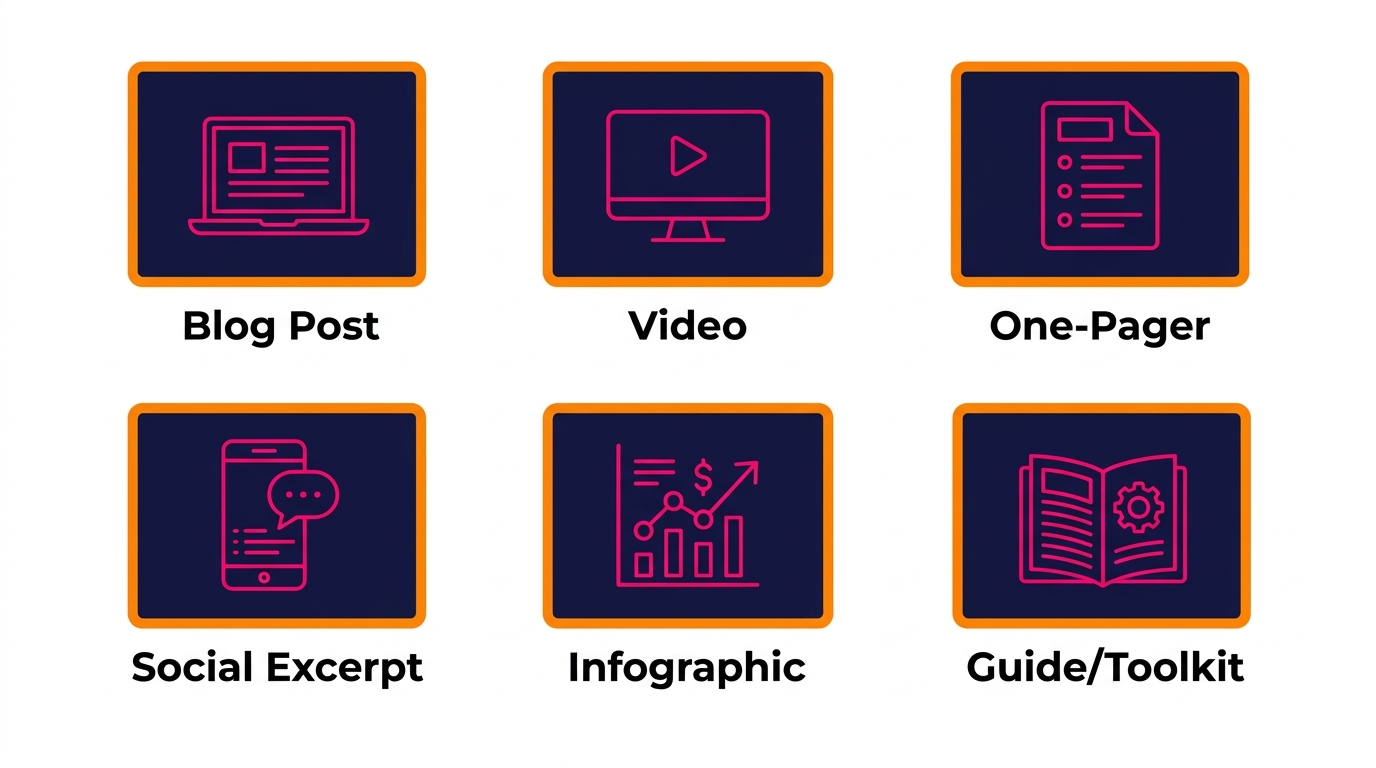
Infographic comparing content formats including blog posts, videos, one-pagers, and social media excerpts for digital marketing

3. Tailor Social Media Excerpts for Each Platform

Every long-form piece you publish contains at least five to ten shareable moments. The mistake most marketers make is copy-pasting the same caption across every platform. That’s not repurposing — that’s recycling, and audiences notice.

Instead, extract nuggets that are genuinely native to each platform’s culture and format:

  • LinkedIn: Pull a data point or contrarian insight and frame it as a thought-leadership post
  • Instagram: Design a quote graphic or carousel breaking down a key framework
  • X (Twitter): Distill one sharp, punchy observation into a thread starter
  • Facebook: Use a relatable problem-agitate-solution format with a link back to the full post

Add platform-relevant hashtags, tag industry voices where appropriate, and always link back to the source content to drive traffic.

4. Transform Written Content into Infographics

Some ideas land harder when they’re seen rather than read.

Statistical comparisons, workflow processes, decision trees, and step-by-step frameworks are all prime candidates for infographic conversion. Infographics are among the most shared content types online — they’re skimmable, visually memorable, and highly link-worthy, which supports your SEO efforts through earned backlinks.

Take a blog post on “How the Google Algorithm Ranks Content” and convert it into a vertical flow diagram. Take a comparison article and make it a side-by-side visual table. The information is the same — the format does the work of making it stick.

Content Format Comparison Table

Original Format Best Repurposed Into Best Channel Primary Benefit
Blog Post Video tutorial, social carousel YouTube, LinkedIn, Instagram Reaches visual/video audiences
Ebook / Whitepaper One-pager, infographic Email, LinkedIn, Sales decks Increases asset accessibility
Research Report Data visualization, social stats Twitter/X, LinkedIn Drives shares and backlinks
Podcast Episode Blog post, quote graphics Blog, Instagram Expands search discoverability
Video Blog transcript, short clips Blog, TikTok, Reels Maximizes content shelf life
Case Study Testimonial graphic, carousel LinkedIn, Website Builds social proof at scale

5. Update and Expand Existing Evergreen Assets

Not all repurposing means changing format. Sometimes the most powerful move is going back to what already ranks and making it better.

Identify your top-performing evergreen articles — the ones that consistently bring in organic traffic — and invest in updating them with fresh data, new sections, improved examples, and current industry trends. A post written in 2021 about social media advertising is a different document by 2026 standards. Refreshing it signals to Google that the content is actively maintained, which can recover or improve rankings.

This approach is particularly high-ROI because you’re not starting from scratch — you’re protecting and amplifying an asset that’s already proven its value.

What to look for when auditing content for updates:

  • Posts ranking on page 2 of Google (positions 11–20)
  • Articles with declining traffic over the past 6–12 months
  • Content referencing outdated statistics, tools, or platforms
  • High-traffic posts lacking video, tables, or structured FAQs
Marketing team reviewing and updating evergreen content on laptops in a modern collaborative workspace

If you’ve been publishing consistently, you likely have a library of posts that cover different angles of the same broad topic. Instead of leaving them scattered, compile them into a single authoritative resource.

Gather five to ten related posts, add connective editorial context, refresh any outdated sections, and publish the whole as a “Master Guide” or “Complete Toolkit.” This pillar content strategy is one of the most effective ways to signal topical authority to search engines while giving users a destination resource they’ll bookmark and share.

For example: combine posts on Instagram strategy, LinkedIn best practices, Facebook ad targeting, and social analytics into a single “The Complete Social Media Marketing Guide for Business Owners.” That one asset can now rank for dozens of long-tail keywords, serve as a cornerstone link target across your site, and be promoted as a standalone lead magnet.

Content Repurposing Action Checklist

Use this before and after publishing any major content asset:

Before you publish:

Identify two to three formats this content could be repurposed into

Note which platforms would benefit from a tailored excerpt

Flag any data or stats that could anchor an infographic or social graphic

After you publish:

Schedule social excerpts customized per platform (don’t copy-paste)

Design or brief a one-pager or infographic from the core insights

Add the post to your content audit calendar for a 12-month refresh

Identify related existing posts this could be compiled with in the future

Record or brief a video version for YouTube/LinkedIn

Frequently Asked Questions

No — as long as you’re adapting the content meaningfully for each format and platform rather than duplicating identical text across multiple pages on your own site. Repurposing for social media, video, or email carries no SEO risk and actively drives traffic back to your original indexed content.

Evergreen content performs best. Focus on how-to guides, strategy breakdowns, comparison articles, and data-driven reports. These have long shelf lives and translate well across formats.

No. Even a solo marketer or small team can build a simple repurposing workflow. Start with one additional format per piece — such as turning every blog post into three social excerpts — and scale from there.

Start with your highest-traffic posts, your highest-converting lead magnets, and your most-shared social content. These have already proven their resonance — repurposing them simply amplifies what’s already working.

Every major content asset — blog posts over 1,000 words, videos, ebooks, and reports — should be repurposed into at least two additional formats before or shortly after publishing. Build it into your workflow, not as an afterthought.

Stop Creating More. Start Multiplying What You Have.

The brands that win the content game aren’t necessarily producing the most — they’re extracting the most value from what they produce. Every blog post, video, and report you create is a raw asset with multiple lives. The strategy is knowing how to unlock them.

Repurpose with intent. Tailor for each platform. Refresh what already works. Compile what belongs together. And let your best ideas reach every audience that deserves to hear them.

For more information about Outreach Brands’ forward-thinking digital marketing services, complete the online request form below.