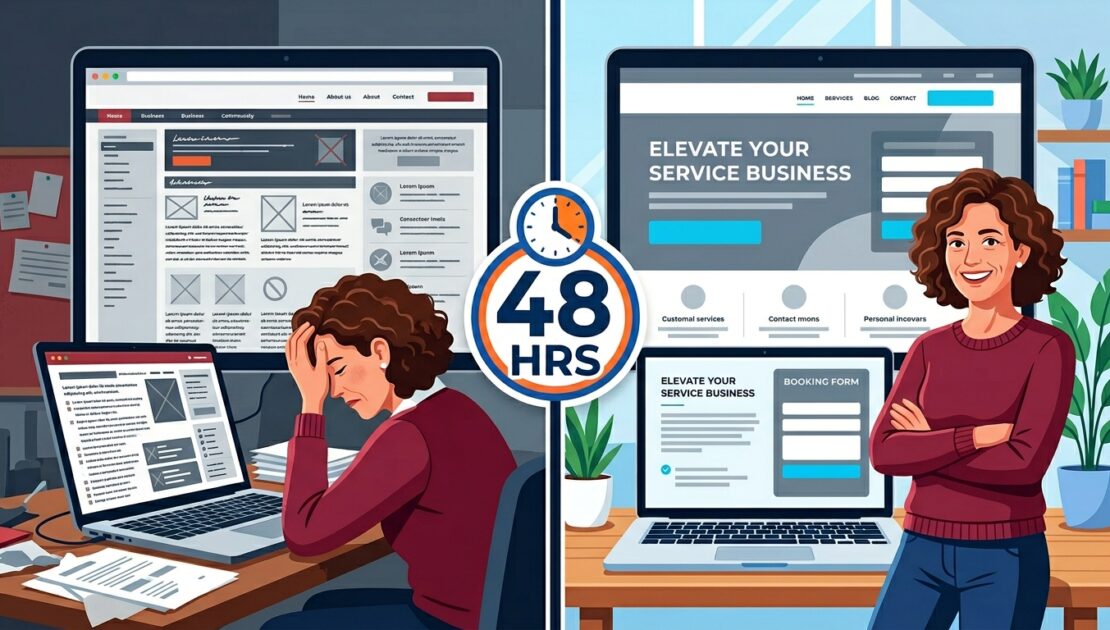
You spent thousands of dollars and/or hours building your website. Maybe you had your website professionally designed and love the end product. You love to send the link to your site to all customers and potential customers. Your website is professional, lightning fast and something you can be truly proud of.
But inquiries? Calls? Contact form submissions?
Almost none.
Here’s a secret that most web designers won’t ever share with you: A pretty website and a converting website are two very different things. And the service businesses who are actually succeeding online aren’t always the most beautiful. They’re the ones that actually understand what a potential customer needs to see, feel and believe in order to do what you want them to do.
This is a teardown. We’ll identify common service site vulnerabilities that lead to vulnerabilities that lead to compromised services, provide real-world examples of each and walk you through a 48-hour plan to fix each one.
You’ve got 3 to 5 seconds to make an impact. So does the average website visitor. This brief window of time is known as the attention span. During this time, you must communicate who you are, what you do and for whom, in order to hold the visitor’s interest. If you are unable to convey these important details, the visitor will move on and you will be left saying “home page, home page, home page” to an empty room.
Many business owners think that the problem lies with the amount of traffic a website receives. They may complain about their website traffic and say things like “I need more customers,” or “I just need more people visiting my site.” Low traffic and low conversion rates are two unique issues. Throwing money at an ad campaign for a non-converting website is like throwing water into a bucket with holes in the bottom. It’s not an effective way to spend your marketing budget.
The upside of conversion problems is that they are frequently reversible. Many conversions can be reversed with little more than a change of direction.
This is the most common mistake we see on the homepages of all types of websites, big and small, in all kinds of industries. The headline on this site used to be like that too.
“Welcome to [Company Name] — Serving [City] Since 2009”
Or worse:
“We are a full-service [industry] company committed to excellence and customer satisfaction.”
No one cares about you. Not because you are an awful person, but because the second you landed on their page, you began talking about the amazing things you’re doing and how wonderful you are. The second you begin to talk about yourself is the second you begin to fail.
The fix: The “About Me” Headline Replace your headline with the customer’s pain or problem they are trying to solve. So instead of talking about the number of years you have been in business, or your level of experience, try this: Stay Cool This Summer — Fast, Reliable AC Repair in [City]. The more you can lead with the customer’s world, and less with your own, the more you’ll attract and engage with the right customers.
Walk through your website and ask yourself one question: What is ONE thing you would like a visitor to do on your site? What is ONE call to action you wish to drive people towards?
If you can’t answer your core questions quickly and confidently, then neither will your visitors.
The biggest mistake made in a service site is one of two things: Either no clear call to action (which leads to confusion and aimlessness for the visitor) or too many calls to action (which leads to frustration and overwhelm when there are half a dozen or so “Call us” buttons, “Get a quote”, “Learn more”, “Like us on Facebook”, “Sign up for our newsletter”, “Download our guide” and so on scattered all over the page).
When everything is urgent, nothing is.
The fix: Choose one primary CTA per page and make it visually dominant. For a service business, this will usually be a lead-generating button such as a phone number, a Get a Free Quote button or a contact form. Ideally there should be no more than one call-to-action on a page, but there should be at least two places on the page where this call-to-action appears.
Service businesses are trust businesses. Your customers decide to become your customers because they trust that you will be competent and treat them fairly. So your website must be a trust-building tool.
The majority of service websites are terrible at showcasing the trust signals that you should be showcasing to give your potential customers peace of mind about your abilities. They list out their services and then post a generic “about us” photo of themselves shaking hands and call it a day. The reality is that a customer is going to have some level of skepticism when they’re considering using a business they’ve never heard of before. And to make matters worse, they’re probably going to find you through Google, which also adds to their skepticism.
The fix: Trust signals to add right now: Real reviews from happy clients with first names and last names and profile pictures where applicable Before and after photos or a gallery of work Professional certifications and licenses displayed visibly on the site Your business address (physical, not PO) A Google review widget with your current star rating Social proof is NOT optional. It drives conversions.
This post is a bit of a tech post, but just a bit. Fun fact – did you know that more than 60% of web traffic is mobile? If your site is slow or not mobile friendly you are literally losing leads to your competition every single day.
A slow website can be frustrating, but it can also cause problems. From the frustration to potential loss of customers, to lost business, to lost Google rankings and more, the consequences can be huge. This year, Google announced that Core Web Vitals will be a new ranking factor in 2021. Unfortunately, the majority of service websites are running on old technology, have too many website plugins and this results in them failing the new Core Web Vitals test.
The fix: Run your site through Google PageSpeed Insights (free and 60 seconds) Sites with mobile page speed scores under 70 are leaving money on the table. Fixing image compression, disabling unused code, plugins and classes, and even switching to a faster web host can make a dramatic impact on website speed. We have seen most small service websites benefit from a 50% or greater speed increase.
Your services page is the second page on your website that people visit after your home page. It is also the page that is most frequently ignored or glossed over. I’ve done a bit of research and I’m yet to come across a services page that is more than a list of bullet points of the services you offer. A list of your services isn’t really an explanation of anything other than what you do. It doesn’t give any real explanation of the value of the service to your customer, nor does it give an idea of whether it would be relevant to their business. It’s just a list of items. You’re not even suggesting the customer do anything with the services you’ve listed.
A list of your services on a page isn’t a sales tool. It’s a menu, and a menu can’t sell anything.
The fix: Update all service descriptions to follow this format: Who is this for: What is the problem: What does this look like: Call to Action: We’ve only added a little bit of contextual information (about 3-4 sentences per page) and have already seen a surge in inquiries.
It’s worth considering the fact that the majority of people visiting your website are not going to become customers today. In reality, the vast majority of people visiting your website fall into one of three categories: – They’re shopping around – They’re researching their problem – They’re thinking about purchasing sometime in the future There’s an awful lot of service websites that give the customer only one option and that’s Call Us Now. Well, the reality is that the people visiting your website are not necessarily ready to call you right then and there.
The fix: A secondary call to action for those that aren’t ready to call for an appointment yet: If someone’s not ready to call for an appointment, what can you offer them that will get them into your database and start you on the path toward becoming a customer? An example might be a free download such as “5 Things to Check Before Hiring a [Service Provider]”, a form to book a free consultation, or a free newsletter with a few tips and hints. This way you’re collecting the lead’s information and can work them toward an appointment over time instead of losing them forever.
You might have the most gorgeous, fastest website in the world, with all the right social proof signals included. And it might not matter what you write on your website, as long as it is generally in the right ballpark. Or you might have a beautiful, fast website with all the right design and user experience elements, with all the right social proof and trust signals included. And it might not matter. The reason is because content relevance to search queries is a foundational element of the digital world. You might have the most beautiful, fastest website on the planet with all the right social proof indicators and it simply wouldn’t matter if the content on your website is not relevant to the search terms and phrases that customers are using to shop and buy online. Likewise, you might have the best-designed, fastest-loading, most trust-building website in your industry and still get almost no traffic if the content on your site doesn’t match up with the search terms and phrases that customers are using to find what they
The majority of service websites pay no real attention to Search Engine Optimisation (SEO) at all or attempt to in a way that is woefully inefficient. They are usually overloaded with keywords, and the text is explained in a long-winded fashion which is rarely relevant, and is almost invariably positioned in the wrong place to have any real ranking value. Google has changed. What actually works in terms of SEO is: helpful, specific, authoritative and relevant content that actually answers the questions that your customers are wanting to be answered.
The fix: The tool I recommend is using Google Search Console or Ubersuggest to figure out the keywords consumers are searching in your service area. Create a page for each keyword that is relevant to your services. Then put the keyword as the main title, description and body of the page. For example if I were a plumber my page about “Why Is My Water Pressure Low? Common Causes and Fixes” is going to start getting way more relevant leads than my page of “Plumbing Services” which is really just a laundry list of problems.
You don’t need to rewrite your entire website from scratch. You need to focus on a small handful of adjustments to the most critical components. Here’s where to focus for the next 48 hours.
Hours 1–4: Audit and Prioritize.
The first step of any web development project is to Audit and Prioritize your site. You need to look at your site with new eyes and examine it in a way that you never have before. You need to use your phone and look at your site like your customers do. You also need to examine your site’s performance and look at your site’s PageSpeed test results. Take note of the following: – places where the site is all about the vendor and not about the customer – lack of Call to Action (CTA) on key pages – lack of trust badges The purpose of Audit and Prioritize is to have a clear understanding of all of the work that is required to achieve a high level of performance, and to determine which work needs to be done first.
Hours 5–12: Fix your homepage headline and CTA
The most important changes to make are on your homepage. Start here: 1. Update your headline to lead with the benefit to your customer 2. Use a single call to action (CTA) and place it above the fold 3. Make your phone number prominent in the header
Hours 13–24: Add trust signals throughout
Ideally we’d have 5–10 genuine testimonials from our clients. We’ll put them on the home page and the services page. We’ll also like to create a photo gallery for any work that we’ve done visually. We’ll also look to add any certifications or awards that we’ve received.
Hours 25-36: Rewrite your services page
The next 12 lessons will be about selecting 2-3 services that you feel are the most relevant to your business. You will rewrite the descriptions for those selected services on your website services page using the following headings: * Who is your target audience for this service? * What is the problem this service solves? * What is the process involved with the service? * What action can you ask the client to take next?
Hours 37–48: Install analytics and check your speed
You need to have Google Analytics and Google Search Console installed on your site. You can’t improve what you can’t measure. I’ll provide a link to a free Google Analytics course in the next section.
You can’t build a website and then just leave it alone. It’s a constant learning curve and communication exercise to understand the needs of your customers and to make adjustments to the content and messaging on your site. But, typically, businesses that see a dramatic increase in lead flow start with the same basic components of: 1) clear messaging 2) clear calls to action 3) trust indicators 4) relevant content that addresses the pain points of your customers.
Your website is not perfect. And your competitors’ websites are probably not perfect either. A slow website, confusing content and a heavy focus on the business, rather than the customer, are all common issues. The good news is that your competitors are likely struggling with the same problems as you. And with the bar set so low for providing a decent website in a local service market, you have a great opportunity to stand out from the competition.
Every website has its problems, and every business has its objectives. A fresh pair of eyes can sometimes be required to determine what, where and when changes need to be made in order to improve the customer experience. However, it’s also important to focus on the right priorities, invest the right amount of time and resources. In our experience, 48 hours of focused attention can transform your website and dramatically improve the user experience. Have a question or would like to know more? We’re here to help.
Start with the audit. Pick the biggest problem. Fix it today.
For more information about Outreach Brands’ forward-thinking digital marketing services, complete the online request form below.