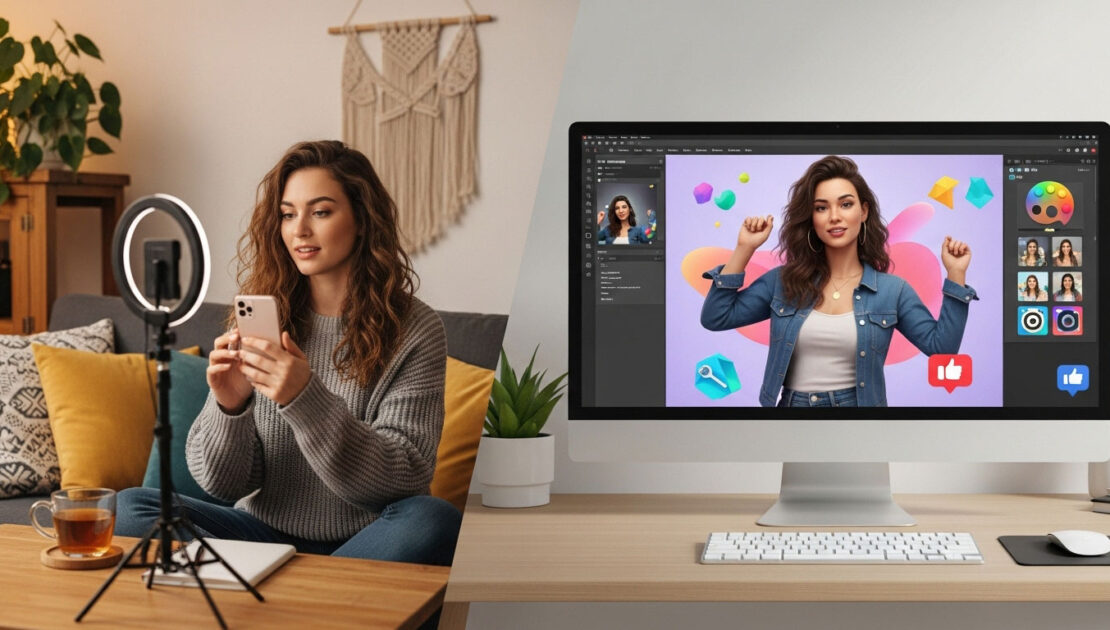
The practice of influencer marketing now uses people beyond famous celebrities for endorsement purposes. The present discussion examines whether micro-influencers who keep loyal fan bases should take over from AI influencers which exist as digital creations made by artificial intelligence models. Both can be powerful. The actual question requires you to identify which marketing approach generates superior return on investment (ROI) for your brand and its particular objectives.
The following section details costs and engagement levels and conversion patterns and risk assessment and measurement methods together with decision frameworks and budget information and a combined solution approach.

Micro-Influencers or AI Influencers: Which Wins on ROI?
31
Oct
Posted by: outreachbrands
Category:
Digital Marketing, Content Creation, Social Media
No Comments
What Counts as ROI in Influencer Marketing?
ROI isn’t just revenue ÷ cost. Most brands use this approach to combine their immediate business results with their permanent brand value growth. Consider:
- Performance: CPA, CAC, ROAS, assisted conversions, affiliate sales, coupon redemptions
- Engagement: Saves, shares, comments, CTR, view-through rate
- Brand: Lift in awareness, consideration, sentiment, search volume, branded traffic
- Efficiency: Content repurposing value, production speed, media rights, legal/safety risk
Simple ROI formula:
ROI (%) = [(Incremental Profit – Total Campaign Cost) ÷ Total Campaign Cost] × 100
Micro‑Influencers: Strength in Authenticity and Conversion
Who they are: The target audience consists of followers who have between 1,000 and 100,000 followers and focus on specific niches while creating strong connections with their audience.
Why they win:
- Trust & Relevance: The recommendation appears as if it originated from a friend rather than being an advertisement.
- Higher Engagement Density: Smaller audiences interact more meaningfully.
- Conversion Power: Human demos, personal stories, and real-world use drive action.
- Content Versatility: UGC that performs across paid social, email, PDPs, and ads.
Watchouts:
- Scalability Overhead: The process of handling numerous creators requires extensive time dedication for briefing and review and invoicing tasks.
- Quality Variance: Creative quality and brand fit can vary widely.
- Supply Fragmentation: The process of coordinating bursts across different regions and languages becomes more challenging.
Best for: Product launches, DTC conversion plays, niche communities, B2B micro‑verticals, brand trust building.
Cost & ROI: Side‑by‑Side
What they are: Virtual personas (static or hyper-realistic) with controllable voice, look, and output cadence.
Why they win:
- Speed & Scalability: Ship assets across languages and formats, 24/7.
- Creative Control: The company maintains a consistent brand voice because it offers immediate revision options and prevents scheduling conflicts.
- Lower Marginal Cost at Scale: Once the system is built, each additional asset is inexpensive.
- Risk Manageable: No human scandals; easier rights and usage terms.
Watchouts:
- Authenticity Gap: Some audiences perceive lower credibility or emotional resonance.
- Regulatory & Disclosure: The company must disclose synthetic content while maintaining complete transparency because public trust will completely collapse when hidden practices become publicly known.
- Creative Uncanny Valley: The execution of a concept fails to deliver authentic results.
Best for: Always‑on content engines, multilingual campaigns, top‑funnel reach, quick testing, and brands leaning into innovation.
Cost & ROI: Side‑by‑Side
| Dimension | Micro‑Influencers | AI Influencers |
|---|---|---|
| Primary Cost Drivers | Creator fees, product seeding, management time, usage rights | Model development, prompt design, licensing, tool costs |
| Time to Launch | 2–6 weeks (sourcing, briefs, content review) | Days to weeks (once pipeline exists) |
| Engagement Quality | High trust, strong comments, saves, DMs | Variable; depends on concept and audience |
| Conversion Likelihood | Strong for mid/low funnel (reviews, demos, how‑tos) | Better for top‑funnel reach/awareness; can convert with strong offer |
| Repurposing Value | Excellent for UGC ads, PDP, email | Excellent for scale, versioning, localization |
| Risk | Human risk (brand fit, conduct), content inconsistency | Authenticity skepticism, disclosure requirements |
Rule of Thumb:
- The first conversion-based KPI makes micro-influencers more effective than other options.
- AI influencers deliver better performance than human influencers when your main goal involves content velocity and reach expansion and large-scale localization efforts.
Measurement: What to Track (and How)
Micro‑Influencers
- Primary: CTR, CPC, CPA/CAC, last‑click and assisted conversions, affiliate sales
- Secondary: The platform tracks two main metrics which include follower-based and view-based engagement rates and saves and share counts and audience sentiment.
- Attribution Tips: Users must create their own UTM links and creator-specific codes and post-purchase surveys which ask customers to identify their discovery source according to the system requirements. Run geo‑holdouts if possible.
AI Influencers
- Primary: CPM/CPV, CTR, cost per engagement, watch time, page/session lift
- Secondary: Brand lift (awareness/consideration), search volume, creative fatigue rate
- Attribution Tips: A/B test AI vs. human variants, track creative wear‑out, run incrementality tests on paid distribution.
Decision Framework: Which Should You Choose?
Ask these five questions:
- Goal: The conversion process or awareness/content scaling approach determines the goal of this objective.
- Audience: Your audience shows preference between human connection and new ideas and original concepts.
- Speed: Do you need assets in days across multiple markets?
- Budget: Your available budget consists of either human fees or AI pipeline resources.
- Risk: Which risk is bigger—human unpredictability or authenticity backlash?
Quick Outcomes:
- Choose Micro if: You need social proof, demos, reviews, and conversions.
- Choose AI if: You need global assets fast, consistent branding, and testing velocity.
- Choose Hybrid if: You want the best of both—human trust plus AI scale.
A Proven Hybrid Blueprint (High‑ROI)
1. Anchor Trust with Micro‑Influencers
- Run 10–30 micro creators in your niche.
- Deliverables: 1–2 TikToks/Reels + 3–5 frames of story.
- The system needs users to obtain usage rights which should last between 6 months and 12 months.
2. Build an AI Content Engine
- The project requires developers to generate 10-20 different versions for each concept which includes hooks and CTAs and locales and formats.
- The system needs to localize captions and on-screen text according to particular market requirements.
- The system needs to generate platform-specific aspect ratios which include 9:16 and 1:1 and 16:9.
3. Paid Amplification & Testing
- Whitelist top micro creators for Spark/whitelist ads.
- A/B test AI vs. human creative on the same audience.
- Rotate hooks every 7–10 days to beat fatigue.
4. Retargeting & Landing Experience
- The platform requires detailed product demonstrations from small content creators to attract users who have already shown interest.
- The system produces AI-generated cutdowns which can be used for site banners and email headers and PDP gifs.
- Add social proof (micro content) above the fold on landing pages.
5. Attribution & Incrementality
- The testing process needs to include UTMs and creator codes and MMM/lightweight geo‑tests.
- Compare CAC and assisted conversions between cohorts.
Sample Budgets & Scenarios
Scenario A: $25,000, launch + conversion
- Micro: 18 creators @ avg $800 = $14,400
- Seeding & Ops: $2,100
- Paid Amplification (Spark/whitelist): $6,000
- AI Creative (tools + prompts + ops): $2,500
- Expected Outcome: The campaign will generate substantial lower-funnel results because AI optimizes variations and retargeting assets.
Scenario B: $15,000, rapid content scale across 3 languages
- AI Engine: $7,500 (setup + 60–80 assets)
- Micro (localized): 6 creators @ $900 = $5,400
- Paid Distribution: $2,100
- Expected Outcome: The system will operate at maximum efficiency through CPM/CPV and content velocity while micro content establishes trust-based proof points.
Brief Templates You Can Reuse
Micro‑Influencer Brief (essentials)
- Goal/KPI: e.g., CPA <$35, CTR >1.2%, 2,000 redemptions
- Audience Insight: Pain points, language cues, barriers
- Key Messages: 1–2 value props + 1 proof (review, stat, case)
- Creative Guardrails: Do/Don’t list, brand tone, mandatory disclosures
- Deliverables: Formats, durations, deadlines, file specs
- Rights & Usage: 6–12 months paid usage, whitelisting permissions
- Tracking: UTM link, unique discount code, post‑timing
AI Influencer Brief (essentials)
- Persona & Voice: Age, style, visual moodboard, tone sliders
- Hooks & Angles: Problem‑solution, before/after, myth‑busting
- Localization Plan: Languages, cultural notes, compliance checks
- Output Matrix: 10 hooks × 3 lengths × 3 ratios × 3 locales
- Disclosure: “Virtual/AI‑generated content” policy and labeling
- QA Checklist: Visual realism, lip‑sync, brand assets, accessibility (captions)
Common Pitfalls (and How to Avoid Them)
- No Clear KPI: Pick one primary KPI per wave; don’t chase everything.
- Under‑investing in Rights: Secure usage rights up front for paid ads and repurposing.
- Creative Fatigue: The system forces users to switch their hooks frequently yet it demands users to refresh their top ads between 7 to 10 days.
- AI Without Transparency: Label AI content; audiences respect clarity.
- Micro Without Fit: Vet creators’ audience demographics, comment tone, and past brand content.
Final Take
- Micro-influencers deliver superior return on investment (ROI) for conversion-based marketing because their audience trusts them and finds value in their social proof and creator expertise.
- AI influencers deliver better investment returns because they produce immediate results at big scales while minimizing content costs for ongoing global marketing campaigns.
- The smart money uses two marketing strategies which include micro-level methods to establish trust and generate sales and AI technology to boost operational speed and content delivery. Test everything while measuring results to confirm what the data shows.
For more information about Outreach Brands’ forward-thinking digital marketing services, complete the online request form below.