Passive content is losing the battle for attention — and the data proves it.
Today’s digital audiences don’t just want to read. They want to do something. They want to answer, explore, compete, and discover. That’s exactly what interactive content delivers — and why brands that invest in it consistently outperform those that don’t.
Whether you’re a business owner trying to reduce bounce rates, a CMO chasing stronger content ROI, or a digital marketer looking to stand out in a crowded feed, interactive content is one of the highest-leverage tools in your arsenal. Here’s everything you need to know about why it works — and how to make it work for your brand.
Interactive content is any digital asset that requires active participation from the user rather than passive consumption. Instead of scrolling through a blog post or watching a video play out, users click, respond, drag, calculate, or choose — and the content responds back.
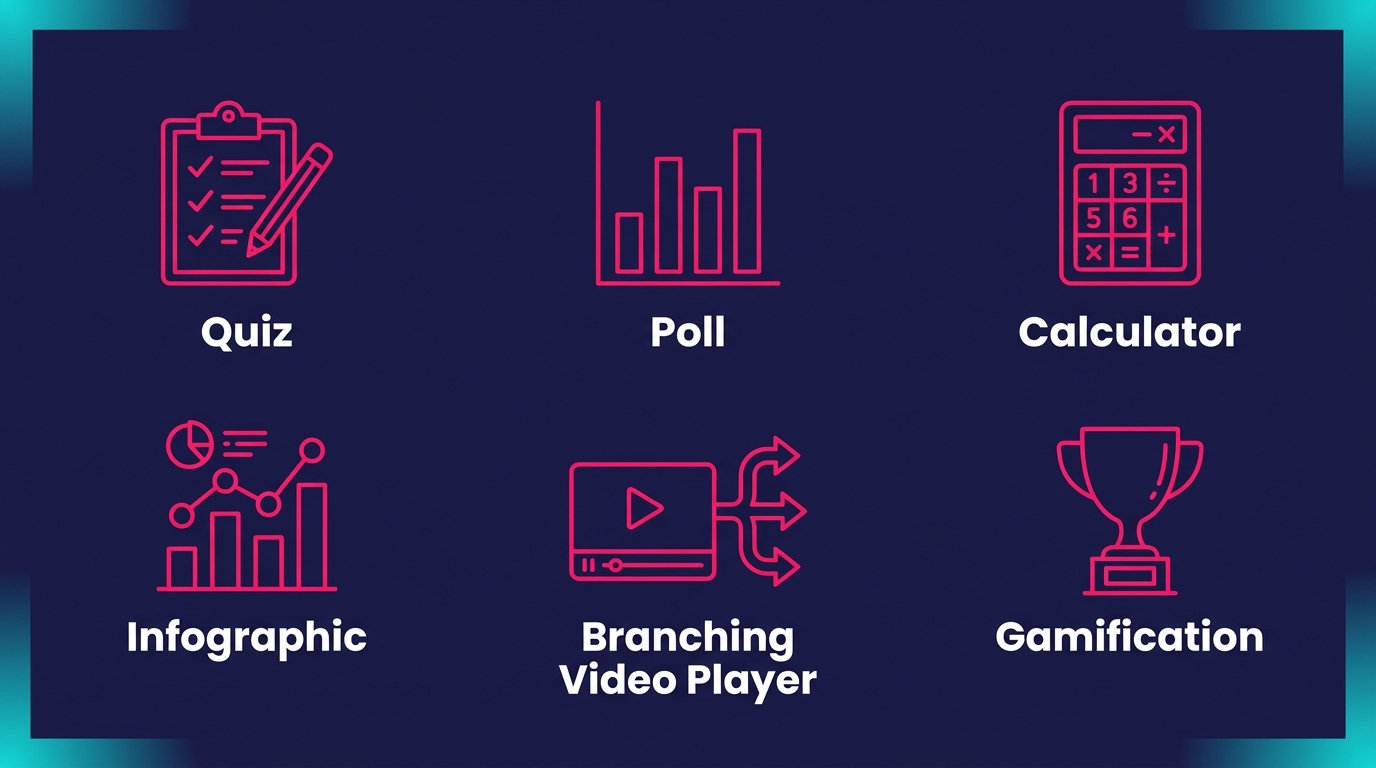
Common formats include:
- Quizzes and assessments that deliver personalized results
- Polls and surveys embedded in social posts or web pages
- ROI calculators and interactive pricing tools
- Interactive infographics that reveal data on hover or click
- Branching videos that adapt based on viewer decisions
- Gamified experiences with points, badges, and leaderboards
- Configurators and product finders that guide purchase decisions
According to Demand Gen Report’s interactive content benchmarks, interactive content generates 2x more engagement than static content on average — and that gap continues to widen as user expectations evolve.
Time-on-page is one of the clearest signals Google uses to evaluate content quality — and it’s also the clearest signal that your audience actually found what they were looking for.
Static articles average around 37 seconds of active reading time before users bounce. Interactive experiences routinely push that figure past 5 minutes. Why? Because interaction creates commitment. Once a user answers the first question in a quiz or inputs their first number into a calculator, they’re invested. They want the result.
This isn’t accidental — it’s psychology. The Zeigarnik Effect describes how people are far more likely to remember and complete tasks they’ve already started. Interactive content activates this loop deliberately. Every prompt, every question, every “next step” keeps users in motion — and on your site.
The bottom line: More time on page signals relevance to Google, reduces bounce rate, and increases the likelihood that a visitor converts into a customer.
Personalization has become a baseline expectation for digital consumers — but true personalization at scale is difficult and expensive when relying on static content alone.
Interactive content solves this elegantly. A quiz that diagnoses a user’s biggest marketing challenge doesn’t just entertain — it segments your audience in real time and delivers a tailored recommendation without any manual effort. A branching interactive video lets two users with completely different needs watch what feels like two completely different experiences — from a single piece of content.
This level of relevance creates something static content simply cannot: an emotional connection. When your content reflects a user’s actual situation back to them, they feel understood — and brands that make people feel understood earn loyalty that advertising alone never could.
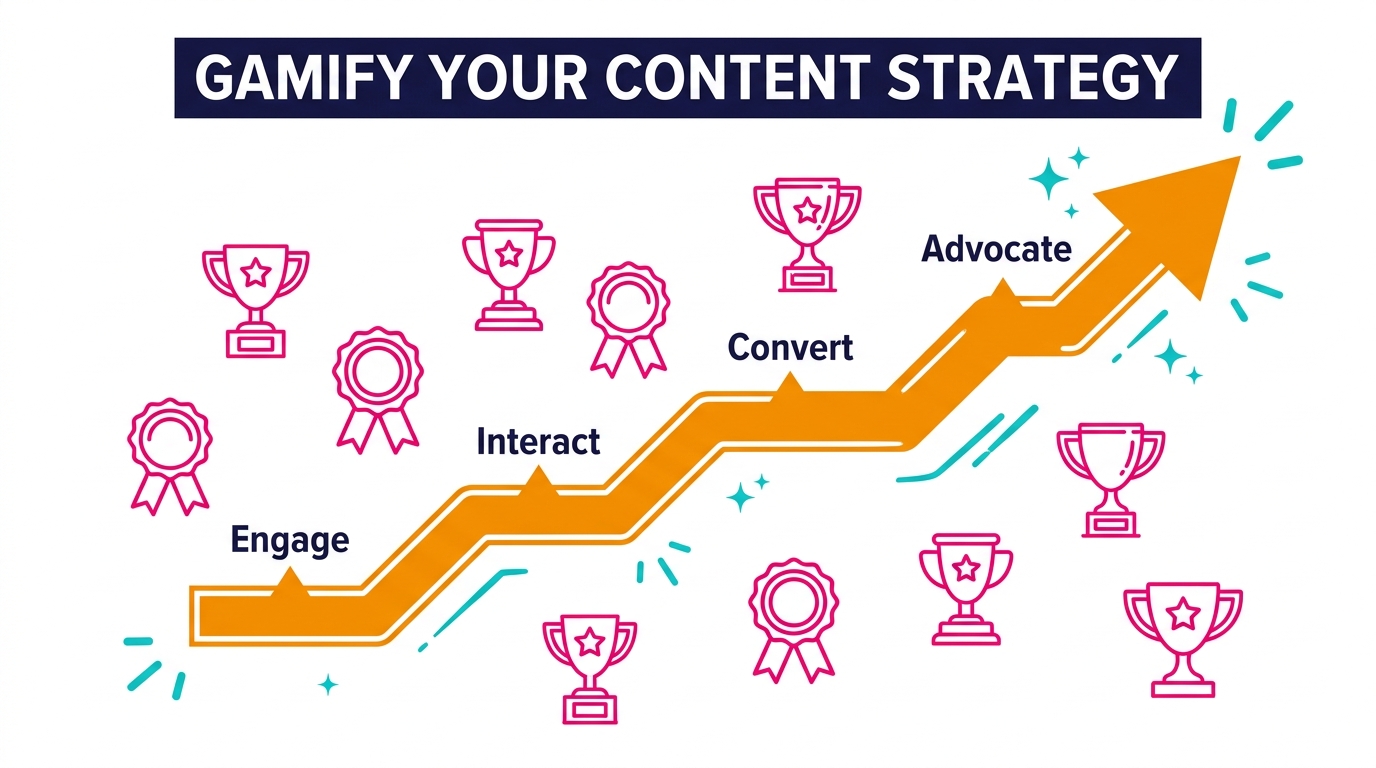
Gamification isn’t about making your marketing look like a mobile game. It’s about applying the psychological mechanics that make games compelling — goal clarity, progress tracking, reward, and social comparison — to your content strategy.
When a user completes a brand quiz and earns a score, they want to improve it. When they see a leaderboard of where their business ranks against industry peers, they want to climb it. When they unlock a personalized marketing audit by completing a five-step assessment, they feel a genuine sense of achievement.
These mechanics tap into deeply human motivators:
- Autonomy: Users direct their own experience
- Competence: Progress creates a sense of mastery
- Relatedness: Sharing scores and results connects users to their community
The payoff? Gamified content is also extraordinarily shareable — which means your brand’s reach expands organically every time someone posts their result.
In a post-cookie digital landscape, first-party data is one of the most valuable assets a brand can build. Interactive content is one of the most effective ways to collect it — without friction, and without feeling invasive.
When a user completes a quiz, fills out an interactive assessment, or uses a ROI calculator, they’re voluntarily providing information about their goals, challenges, budget, and preferences. That data flows directly into your CRM or email platform, segmented and ready to act on.
Compare that to third-party cookie data: anonymous, deteriorating in accuracy, and increasingly unavailable as platforms deprecate tracking. First-party data from interactive content is:
- Voluntary — users provide it by choice
- Accurate — they answered directly, not inferred from behavior
- Segmented — their responses tell you exactly where they sit in your funnel
- Actionable — you can tailor follow-up emails, ads, and offers immediately
Brands using interactive content for data collection are building a durable competitive advantage that paid media alone cannot replicate.
Social sharing is the most cost-effective distribution channel available to any brand, and interactive content is disproportionately likely to be shared.
Why? Because sharing interactive content serves the sharer’s social identity. When someone posts their personality quiz result or shares a “find out what type of marketer you are” tool with their network, they’re not promoting your brand — they’re expressing something about themselves. Your brand just comes along for the ride.
This virality mechanism is powerful because it carries social proof. A recommendation from a peer carries far more weight than a paid ad from a brand. Every organic share of your interactive content is effectively a personal endorsement — and it costs you nothing in media spend.
Maximize shareability by:
- Placing a clear share prompt at the results screen
- Making results visually attractive and easy to screenshot
- Framing results in a way that flatters the user (“You’re a growth-focused visionary!”)
- Offering a short, memorable link for direct sharing
| Factor |
Static Content |
Interactive Content |
| Average dwell time |
37 seconds |
3–5+ minutes |
| Audience personalization |
Minimal |
High (real-time) |
| Data collection |
Passive (analytics only) |
Active (self-reported) |
| Shareability |
Moderate |
High |
| Engagement rate |
Lower |
Up to 2× higher |
| Production complexity |
Low |
Medium to high |
| Lead generation potential |
Indirect |
Direct |
| SEO dwell time signal |
Weak |
Strong |
The takeaway is clear: static content still has a place in your strategy, but interactive content amplifies nearly every metric that matters to growth.
Getting started doesn’t require a massive budget or a development team. The right tools and a clear strategy are all you need.
✅ Step 1: Define your goal — lead gen, engagement, education, or segmentation?
✅ Step 2: Choose the right format — quiz, calculator, poll, assessment, or interactive video?
✅ Step 3: Map the user journey — what does the user input, and what do they receive?
✅ Step 4: Write branching content — create outcome pathways for different user responses
✅ Step 5: Design for your brand — apply your color palette, typography, and tone consistently
✅ Step 6: Integrate with your CRM or email platform to capture and use collected data
✅ Step 7: Publish and embed — on your website, in email campaigns, and across social
✅ Step 8: Analyze performance — track completion rates, drop-off points, and conversion events
✅ Step 9: Iterate — use the data to improve the experience for the next round
Tools worth exploring include Typeform for quizzes and surveys, Outgrow for calculators and assessments, and Ceros for full-scale interactive content experiences.
Not at all. Platforms like Typeform, Outgrow, and even Instagram’s native poll and quiz features allow businesses of any size to create interactive experiences with minimal investment. Start small with a single quiz or poll and build from there.
Static content built the internet. Interactive content is what keeps people coming back.
In 2026, the brands winning the attention economy aren’t the ones publishing the most content — they’re the ones publishing the most useful content, in formats that invite participation, reward curiosity, and create genuine moments of connection.
The technology is accessible. The playbook is proven. The question isn’t whether interactive content delivers — it’s whether your brand will leverage it before your competitors do.
Unlock more engagement, drive stronger results, and build the kind of brand loyalty that outlasts any algorithm change. The tools are ready. Your audience is waiting.
For more information about Outreach Brands’ forward-thinking digital marketing services, complete the online request form below.